Embracing or rejecting short-termism (or both?)
Remember: you’re a software engineer working on a webapp in 2016. Yesterday, during sprint planning, you were assigned a list of tickets for the two-week sprint. Your MapReduce script is running, so you have some time to browse Hacker News. You read about yet another promising web framework that your frontend teammate might want to pitch to your CTO in a year or two. Meanwhile, you’ve been telling yourself it’s time to learn Spark. You want to become the data engineer every company will want on its team in two or three years, when you quit your job. You know time will go fast.
Well, it did. But 10 years later, you now have a different definition of fast. I don’t think I’m exaggerating when I say that our daily work as engineers changes as much in one month as it used to in a year. A good sign of that is how frequently I’m switching between IDEs these days.
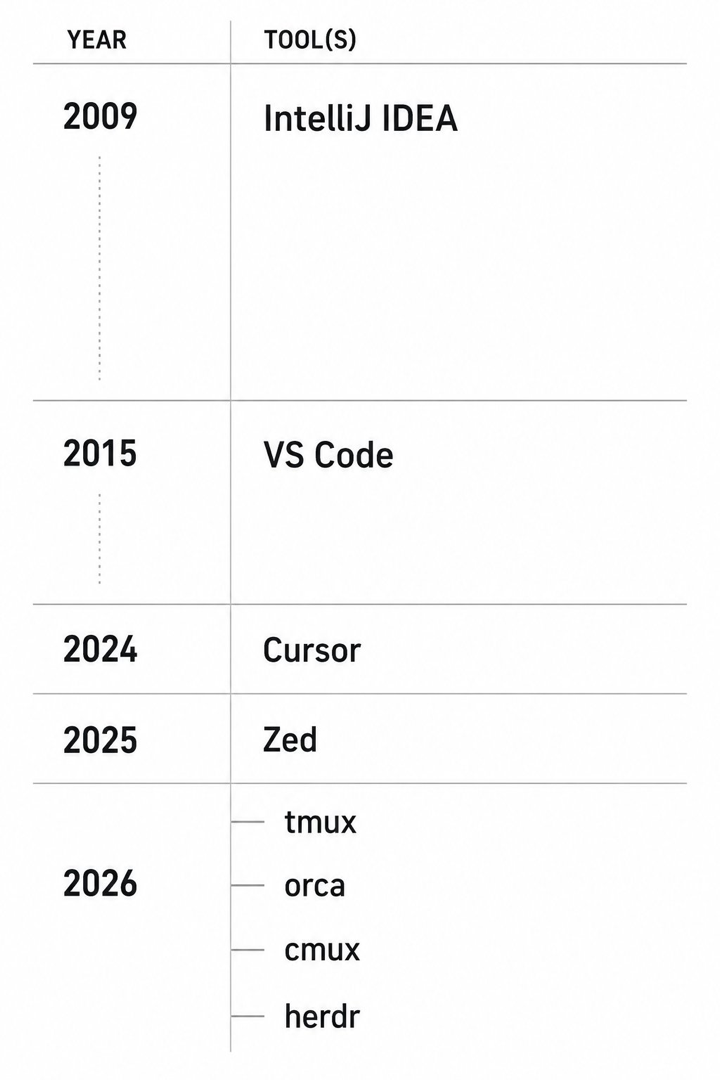
It can be overwhelming, for sure. I don’t even know if we humans are built for this. How long can we keep adapting to a period like this? What if it continues for 5, 10, or 15 years? Many people expect AGI within 3 years, as though it would finally lift the veil on our future and put an end to this uncertainty. I don’t believe that. I suspect we’ll go through this transitional period for years, without getting a clear answer about where we’re heading.
Many of us are now experiencing the sugar rush that came with social media. I managed to stay away from Instagram for years, and X and HN were the only two feeds I could browse calmly, without losing control of my consumption. But now, I feel both the urge to quit them for my sanity and, conversely, to spend all my time on them to figure out how to navigate this uncertain future.
We’re living with constant FOMO, watching our industry crumble, afraid of ending up in the “permanent underclass”. We reassure ourselves by thinking we won’t be the only ones in this situation. We think about the plumbers, electricians, and bricklayers who will someday lose their jobs to robots, too. But that day is still far off, and a builder’s daily life is spent waiting for the bricks to arrive or for the weather to clear. Near my place, there’s a huge construction site for a new library that’s been halted over some irregularity. It will probably remain frozen for a year or two. In the meantime, I’ll probably have switched between a dozen new IDEs.
So what do we do?
Well, even if I might sound negative in this post, I think we have to stay short-termist to stay in the game. I think it’s simply part of the deal we signed up for when we chose this career. When I started my career 15 years ago, I complained about how slow things were. At Scribay, my first startup, I remember being very frustrated by how long it took to transform our existing Play!-based client-server webapp into a full React SPA. That’s not the case anymore. Our job has definitely changed, and as the saying goes, “When in Rome, do as the Romans do.” Anyone who still wants to ride the software engineering train needs to adapt to the new tools and practices. As a founder, I probably wouldn’t hire someone who isn’t actively experimenting with AI. Not because everyone needs to know about orca, cmux, herdr, conductor, superset, [please contact me to add your homemade IDE], but because curiosity about new AI practices has become part of the job.
At the same time, I wonder what will be left of us if we spend these years of profound transformation simply chasing the short term and developing skills that become obsolete a year later. Prompt engineering is a good example. It’s not a matter of careers: I know there will still be a need for software engineers in the coming years, if only because every system needs an owner, and yelling at someone is still far more rewarding than yelling at an agent. But many of us are curious tinkerers who need to feel a sense of progress and self-improvement. If we don’t, we’ll just end up being the cork/the rock/the leaf in one of the most beautiful songs by the Beach Boys, ‘Til I Die.
I’m a cork on the ocean
Floating over the raging sea
How deep is the ocean?
How deep is the ocean?
(I lost my way, hey, hey, hey)
I’m a rock in a landslide
Rolling over the mountainside
How deep is the valley?
How deep is the valley?
(It kills my soul, hey, hey, hey)
I’m a leaf on a windy day
Pretty soon, I’ll be blown away
How long will the wind blow?
How long will the wind blow?
Until I die
These things I’ll be until I die (‘Til I die)
So I think we need to find something to pursue over the long term. And to be honest, I’m not sure plain software is the answer, because short-termism keeps undermining your long-term plans. You’ll end up finishing your MVP in two days. So what? What comes next? A new version, with no users?
There’s also the temptation to ask Claude or ChatGPT what new skills we should develop. And sure, they’ll help, but you’ll remain stuck in the functional, pragmatic way of living that agents tend to lock us into. With them, everything becomes a means to an end. We’re just optimizing ourselves.
So I think our best bet is to stop being so functional. The current situation, along with our daily use of AI, encourages us to be very rational about every decision. We end up doing what we’re told is good for us rather than what we really want. That’s not why we chose this job in the first place. We chose it simply because it was fun. So we need to find that fun again, and maybe it’s not in pure software anymore. And maybe the way to find it is to start being slow again, somewhere between two highly functional, highly connected agentic engineering sessions.
I know, I’m once again ending a blog post on a platitude. But this one was 100% slowly written by a human.